Dom Sebastiao at Alcala Subastas

Portrait of Dom Sebastiao of Portugal bearing the Order of Christ cross, Spanish School, circa 1600-1630, 210 x 119 cms, with inventory nr 428.ha.

Provenance: Collection Marqués de Leganés, nr 428 (inventory of 1655); Colección Duque de Sesto.

Se trata de uno de las últimas representaciones del Rey D. Sebastián, basado en un retrato desaparecido pintado en Portugal antes de su partida hacia África donde moriría en la Batalla de Alcazarquivir en 1578. Tras su muerte, éste último retrato serviría de modelo a muchos otros como los dos atribuidos a Sánchez Coello, que se conservan en el Museo de San Telmo y en el Kunsthistorisches Museum de Viena, ambos de medio cuerpo. Así pues, este retrato sería probablemente la única obra conservada que representa a D. Sebastián de cuerpo entero como adulto.

Esta documentado en la colección del Marqués de Leganes desde 1637, apareciendo por última vez en el inventario de la Colección Altamira de 1726.

Aunque en el inventario realizado a la muerte del marqués, en 1655 figura con el nº 428: “otra del mismo tamaño [de medio cuerpo]del Rey Don Sebastián”, en el de 1726 se enmienda el error, describiéndose como un retrato de cuerpo entero.

Agradecemos al doctor D. Jose Juan Pérez Preciado su ayuda para la catalogación de este lote.

Alcala Subastas – May Sale.

Isabella of Portugal

Portrait of Isabella of Portugal, c. 1445, Workhsop of Rogier van der Weyden, oil on panel, Getty Museum.

Afternoon at the Getty

Image

Good Friday


Pieta, Germany,1375-1400, Cloisters, Metropolitan Museum

Bomarzo

When reading good books, they immediately make us more aware of its themes on our daily lives. Two good friends recently made me read Bomarzo, a novel by Manuel Mujica-Lainez, which tells the story of the Renaissance prince Pier Francesco (Vicino) Orsini, Duke of Bomarzo, a mentally weak and corrupt hunchback that lived among the 16th century great.

His greatest legacy was, without a doubt, the garden of monster sculptures he created at Bomarzo Castle, still existing, and that, by the end of the book, finally appears as to frame this perturbed mind which lifetime goal was to find a way to live eternally.

UNIQUE “PIETRE DURE” FIGURE OF PAOLO GIORDANO ORSINI, DUKE OF BRACCIANO FLORENCE, GRAND-DUCAL WORKSHOPS, circa 1620-1625, Probably after a model by Orazio MOCHI (1571-1625), Black paragon marble, chalcedony, agate, bronze, J.Kugel Antiquaires, Paris.

While reading it, I had to do my stint at TEFAF in Maastricht last month. As every year, we always discuss among friends, which is our favourite piece at the fair. Of the many treasures there, this year I couldn’t resist saying it was Kugel’s small statuette of Paolo Giordano Orsini, Duke of Bracciano. I had seen it last year, but now it became even more special to my eyes.

A truly exquisite pietre dure piece, out of the Florentine Grand Ducal workshops, portrays him on a kneeling position, which the author of the catalogue entry mentions that it is “probably in the position of allegiance to the Emperor, as he received the title of Prince of the Holy Empire”. It almost seems that Mujica-Lainez knew this statuette when he narrates the imaginary knighthood granted to Vicino by Charles V at his coronation. Two different Orsini, but Vicino, always proud of his lineage and its main figures, would certainly include Paolo Giordano among the most illustrious editus orsae.

Last Night

Indo-Portuguese cabinet

ImageImageImage

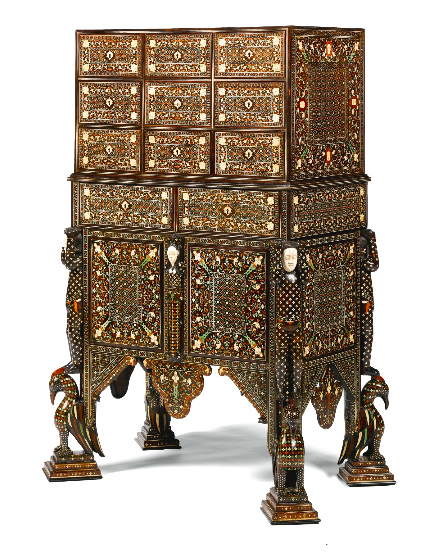
To be sold by J.E. Prunier, Commissaire-priseur on the 15th April, this wonderful contador, was possibly made for the Vice-King of Portuguese India, Dom Duarte de Menezes, of the Condes de Tarouca, between 1584 and 1588.

Lot 166 Cabinet d’apparat marqueté toutes faces en bois précieux de santal (ou de teck de Birmanie), ébène incrusté d’ivoire, fils d’or et pierres semi-précieuses, à décor floral et étoilé dit “au perroquet”. La façade ouvre à 19 tiroirs à boutons d’ivoire, le tiroir central orné d’armoiries de chevalier.

Travail moghol exécuté pour une grande famille portugaise, circa 1580.

H. 38, L. 85, P. 36 cm.

estimation basse : 10000Euros – estimation haute : 12000Euros

Hospitality

Anonymous

anonymous-movie-image-04

17th century Portuguese furniture in 16th century England – Anonymous, the movie, where Shakespeare is a fraud.

Musee de la Chasse et de la Nature

Last December, walking around the Marais district, in Paris, I passed by door of the Musee de la Chasse et de la Nature, which I had a vague idea of having seen some pictures of on a magazine. As I wasn’t that busy, I have decided to go in straight away and found one of the most well done museums I ever seen.  To resume in one sentence, it is what a museum should be: entertaining, pedagogical, surprising and with great quality of the pieces exhibited.

A good collection of arms and hunting related objects, a significant group of paintings by painters such as Cranach, Rubens, Brueghel or Desportes, some wonderful taxidermy pieces, punctuated with appropriate (commissioned) pieces of contemporary art. All beautifully displayed and put in context by informative cabinets.

It’s all about the money

As the Hudson Valley is beautiful, the taste of the Vanderbilts is not. In a breathtakingly beautiful setting, an architecturally decent house, and a very sad interior. The Vanderbilt Mansion on the Hudson.

Bowery

Walking up the Bowery recently, on an incredibly cold day, I was stunned to see a huge line of visitors waiting to get into the New Museum. Quickly, I remembered that Carsten Holler’s Experience exhibition was on, with his famous slide and tank. I doubted that 99% of the crowd had heard of Relational Aesthetics, Bourriaud or anything of that sort. Bottom line, what really counted was to tell you’re their friends that they haven’t been to slide in the museum. Good luck in getting strange diseases.

Barry X Ball, Purity, white iranian onyx (Sperone Westwater) - after Antonio Corradini.

Anyhow, a few meters north, at Sperone Westwater, two other – much more interesting – exhibitions had just a handful of visitors. On the top floor, “Portraits/Self-Portraits from the 16th to the 21st Century”, while on the two first floors “Marble Sculpture from 350 B.C. to last week”.
The first had some truly word class works – the portraits by Ghirlandaio and Palma, the Younger were fantastic – but it lacked a sense of unity to the overall exhibition. Having separated the 20th and 21th century pieces in one floor and the rest in another, not only re-enforced this idea of being a random selection of wonderful portraits, but also diminished, in our opinion, the energy of the modern works, that lacked the gravitas of the traditional paintings.
The exhibition dedicated to marble sculpture was intriguing, surprising and very enjoyable, exploring several routes of the expressionistic qualities of the material and with a much better dialogue between the different chronological periods. Highly recommended.

Last night


Howler at Piano’s – NY Times

Why Art Is a Sensible Investment — Just Not for You

Investing in the “art market” is essentially throwing your money into an unregulated market. It’s extremely risky and should not be undertaken by anyone without bottomless capital and a superior knowledge of the industry. It’s been compared to other luxury “alternative investments” like gold or even real estate (…). But buying the kind of art that might make you money is more in the realm of buying a sports team (…). The fan-owned Green Bay Packers notwithstanding, neither sports teams nor major art purchases are investments that should be undertaken by the layman, but they are still investments that can pay off when done right — and that’s a distinction that should probably be made more clearly more often. (Artinfo).

Mallett at Ely House

Mallett is moving from Bond Street to the nearby Dover Street, to Ely House, built for the Bishops of Ely by the architect Robert Taylor in 1772-6 . The move will happen in early March 2012.

Marialva’s Breughel

Jan Breughel II (Antwerp 1601-1678), The story of Adam and Eve, all signed 'J. Breughel', oil on copper inset into wooden supports.

Browsing the forthcoming Christie’s Old Master Paintings catalogue of 25th January, I stopped at a wonderful set of six paintings by Jan Breughel II depicting the Story of Adam and Eve. The lushness and richness of the scenes were enough to ignite my interest but curiously enough the provenance showed me that the set had belonged in the 19th century to two collections I have had to briefly study in the past. First, to the collection of the Marquis of Marialva, Dom Pedro de Meneses, and then to the Duke of Newcastle, at Clumber Park. Dom Pedro, friend of William Beckford and Portuguese ambassador to Paris, died without direct heirs and his collection and library were sold in Paris, though later than the 1814 date noted. I wonder if this set is mentioned in the sale catalogues. Anyhow, I am now truly curious to see these wonderful paintings soon at Sotheby’s later this month.

Museu de Arte Antiga’s new acquisition

CYRILLO VOLKMAR MACHADO (1748-1823), The Last Supper, pencil and ink on paper, 34 x 23 cm

The National Museum in Lisbon recently acquired an interesting drawing by Cyrillo Volkmar Machado, a study for an altar of the Church of São Sebastião da Pedreira. Not only is a wonderful piece which will complement the museum’s drawings collection but it is worth to note that it was acquired with funds provided by a private donor, rare rare thing in a country where gifts and patronage of museums seem almost non-existing, especially in the old masters and antiques world.

Wideville in December

The 18th century way of living still exists with good taste and flair. And outdated is your mother!

Adoration

The Adoration of the Christ Child, Follower of Jan Joest of Kalkar (Netherlandish, active about 1515), Oil on wood, The Jack and Belle Linsky Collection, 1982 (1982.60.22) © Metropolitan Museum of Art -  This artwork is currently on display in Gallery 537.

Com saudacoes ao Mestre Luis, senhor do Belo.


December’s Sun

Today, on the terrace at Sao Vicente de Fora Monastery, I only needed a few seconds to confirm that it is indeed the most stunning place in Lisbon. The church, the quietness of the cloisters, the always empty royal pantheon, the whiteness of the sandstone and probably the most important set of Portuguese baroque tiles in the world, makes it such a great experience to explore it. And then you get to the terrace and see the view.

Mapplethorpe a Paris

Working with the Mapplethorpe Foundation and inviting Sofia Coppola to curate it, Galerie Thaddaeus Ropac organized an exhibition on the photographer’s work which is simply sublime.

Leaving aside the so well known nude images, the film director made art curator picked a group of beautiful photos, many of them unpublished, from the foundation’s archive, which reveal a truly serene Mapplethorpe. Until January 7th.

Au Louvre

But I don’t wear woman’s shoes.

Through House of Jonn.


Jeff Wall


Jeff Wall – Boy falls from tree, 2010, 120 3/16 x 89 in. (305.3 x 226 cm), Lightjet print


New exhibition at White Cube Mason’s Yard.


F±@g genius

All: Cattelan

Saatchi strikes again

“Being an art buyer these days is comprehensively and indisputably vulgar. It is the sport of the Eurotrashy, Hedge-fundy, Hamptonites; of trendy oligarchs and oiligarchs; and of art dealers with masturbatory levels of self-regard.
(…)
Do any of these people actually enjoy looking at art? Or do they simply enjoy having easily recognised, big-brand name pictures, bought ostentatiously in auction rooms at eye-catching prices, to decorate their several homes, floating and otherwise, in an instant demonstration of drop-dead coolth and wealth. Their pleasure is to be found in having their lovely friends measuring the weight of their baubles, and being awestruck.
(…)
If I stop being on good behaviour for a moment, my dark little secret is that I don’t actually believe many people in the art world have much feeling for art and simply cannot tell a good artist from a weak one, until the artist has enjoyed the validation of others – a received pronunciation.”

Charles Saatchi: the hideousness of the art world. Guardian.

Blaufuks on 25th street

I’ve bumped into a Blaufuks photo on 25th Street.

Justin Townes Earle

Some rare times it doesn’t feel utterly awkward embracing America. It happened yesterday night at the Carnegie Hall with JTE.

Sculpture

Trophy art is becoming more and more irrelevant to my eyes and lately I find myself finding sculpture of all sorts surprising, revealing and an excellent counter balance to the lack of material values and principles with which some of that art is lived.

While a snowstorm painted New York white recently, the crowds looked for cover at MoMA, temple of trophy and post card art. I, with friends, did exactly the same and was suddenly surprised by the sculptures of Cy Twombly, things I did not even know that existed.  This special, and small, exhibition, presented the most subtle and mesmerising sculptures I have seen in a long time, a prefect complement for the white day happening.

On a different weather setting, and a couple of weeks later, I was at the Museu de Arte Sacra de Sao Paulo, a repository of the wonderful baroque spirit which travelled with the Portuguese to Brazil. Even if lacking the magnificence of the European originals, the images found there are wonderfully revealing expressions of devotion, images full of humanity.

And on that note, of humanity on sculpture, nothing beats the Spanish sculpture of the 17th and 18th centuries, which recently has been having a lot of international attention, specially after the exhibition at the National Gallery in London, Sacred Made Real. Therefore, it shouldn’t be missed, at the Museu Nacional de Arte Antiga in Lisbon, what must be a superb exhibition on this subject – Cuerpos de Dolor, with works by the masters of that time, Pedro de Mena, Pompeo Leoni, Alonso Cano and others.

On guarantees

“The auction houses are also helping to boost the market and reduce volatility through a nifty trick called a “third-party guarantee” or “irrevocable bid”, through which they sell a work before the auction for a minimum price. This becomes the “reserve” below which the artwork will not sell. The guarantee gives the seller the confidence to consign a work and other potential bidders the reassurance that there is somebody out there willing to buy it. However, these financial agreements are secret and riddled with potential conflicts of interest. Many dealers, such as David Nash, a partner in Mitchell-Innes & Nash, argue that they distort the free market.”

The Economist blog Prospero.

Eames: The Architect and The Painter

The English Prize

From next May, the best of the “English Prize” will be assembled and shown at the Ashmolean – bringing visitors a unique time capsule of the tastes, characters and groaning shopping bags of Britain’s 18th-century super-rich gentlemen. For scholars of the Grand Tour, it shows not only what art the grand tourists were buying, but also what books they were reading to while away the journeys and what souvenirs they were sending back for their friends and families. It provides the most complete picture yet of an influential moment in the history of British taste and learning.

Ines D’Orey

Ines D'Orey, Porto Interior, corredor no bonjardim #1, 2010

Porto Interior.


They all recycle

“Jeff Koons talks about buying the art of past masters whose influences resonate through his own work.
In the Financial Times.

Artists have always collected the work of earlier masters. Some, such as Vasari, Lely, Rubens or Reynolds, ranked among the greatest collectors of their day. Earlier this month, at the impressive new specialist Old Master paintings fair, Paris Tableau, a loan exhibition unveiled three pictures from the hitherto rather private collection of Jeff Koons. And while Andy Warhol’s dazzlingly successful spiritual heir is not the only contemporary artist to buy Old Master and 19th-century paintings, drawings or sculpture, the creator of floating basketballs, 43ft topiary puppies and gleaming steel bunnies may not seem the most likely among his peers to be haunting Neapolitan baroque churches or flicking through auction catalogues.
Yet Koons has long engaged with Old Master paintings and sculpture in his own work (there is a peerless artistic pedigree for that too). What is remarkable here is the extraordinary range of his magpie borrowings.

Calca de Ginastica

Le Masp

A pleasant surprise. More to follow.

Nicki Minaj & Francesco Vezzoli

Rococo Portrait of Nicki Minaj as Jeanne Antoinette Poisson, Marquise de Pompadour by Francesco Vezzoli

Interview in W with Vezzoli.

The Joys of Collecting


Newly republished.

At Francesca Galloway

Ivory and Tortoiseshell-veneered Cabinet Ceylon, for the Portuguese market, late 16th–17th century Height: 42.5 cm Width: 51 cm Depth: 32.5 cm Wood, veneered with panels of openwork ivory over tortoiseshell and gold leaf, with silver mounts

Ivory & Painting. Indian Goods for the Luxury Market

M3 Chair

An oakwood chair by Thomas Feichtner.


Sandro Perri

Video by Pedro Maia

Adam Lindemann on Richter, Kassay and the market

Adam Lindemann is the most interesting person writing about the art market at the moment. A major collector, he has an honest and straightforward insider’s view on it and he doesn’t have any problem in putting his opinions out there, disregarding fashion and trends on one hand and the skeptic or even demoniac views on the market on the other:

With so much trouble in the world, and people protesting the financial crisis in Greece, and dictatorships in the Middle East, and when there’s even a fascinating and worthy Occupy Wall Street movement germinating in our own city, it’s easy to see why artists would shake their heads in disapproval at escalating art prices; most of the world doesn’t have adequate health care or enough food to eat, including too many in our own country. But that knee-jerk view is too facile, because all the money spent on art the world over in an entire year wouldn’t make even a small dent in any of these macro problems. I am in favor of helping people in need, but not at the expense of culture; I’m not a moralist.

We’d all feel better if the artists produced less, the galleries sold less, the museums did fewer and better shows and the collectors bought less of it for a while—at least until the world settles down a bit. Everyone in the art world has enjoyed the benefits of the monetary appreciation of art, so I don’t have much patience for those who complain about it. Perhaps what Richter really meant is that his art is worth more than everyone else’s, in which case I agree with him. But I’m not offended by what someone can afford to pay for a Richter, I’m just jealous.

Idris Khan

Idris Khan - every... William Turner postcard from Tate Britain, 2004 Lambda digital C print mounted on aluminium

Last Chance


Sentados em Madison Square, um aviao passeava por cima das nossas cabecas. Publicidade? Declaracao de amor?
Nao. So mais um art project em NY, da autoria de Kim Beck.
Details no New York Observer.

Obra de Helena Almeida comprada pela Tate

Serota said Tate itself earmarked 1 million pounds to 1.5 million pounds a year of its tax-funded grant to buy art. The gallery — using 150,000 pounds given to it by the Outset Contemporary Art Fund charity — spent 120,000 pounds of that money at Frieze yesterday on works by three women artists: Poland’s Alina Szapocznikow, Portuguese-born Helena Almeida and Melanie Smith.

Storm King Park

A apenas uma hora de Nova York, o Storm King Art Center é um parque de esculturas que vive acima de tudo do magnífico cenário em que está inserido. Um perfeito dia de sol de Outubro, com a folhagem do vale do Hudson a perder o verde para o cor de laranja, levou-nos a experimentar os 250hectares e uma centena de esculturas.
Apesar desta envolvência falta-lhe uma naturalidade no posicionamento das obras que pude ver no único parque de esculturas comparável que conheço, o Yorkshire Sculpture Park. Mas entre uma mão cheia de peças de Mark di Suvero, Calder, Henry Moore, Anthony Caro e Roy Liechenstein foram precisamente aquelas que melhor se enquadravam na paisagem que me ficaram na memória, Richard Serra e Andy Goldsworthy.

King Krule

formely known as Zoo Kid

Infinite Jest

"From Sir William Hamilton's Collection", by James Gillray, hand-coloured etching, published 8 May 1801

A proposito da exposicao Infinite Jest: Caricature and Satire from Leonardo to Levine, no Metropolitan Museum of Art, duas gravuras de Gillray gozando com Sir William Hamilton.

James Gilray, A Cognoscenti Contemplating the Beauties of the Antique, 1801

Garantias

Para se perceber como as leiloeiras se transformaram em verdadeiros veiculos de investimento financeiro favor ler este artigo de Judd Tully. A diferenca para as instituicoes financeiras que fazem o mesmo e’ que a regulacao e’ minima. Os leiloes ha muito que deixaram de ser a hasta publica onde os valores das pecas sao definidos pelo mercado. Este jogo acabou e agora os compradores sao apenas joguetes nas maos do duopolio da Christie’s e a Sotheby’s. Quem quer joga, quem nao quer fica de fora.

Andre Cepeda

Esta serie de fotografias – Ontem – que apenas conheci hoje, de Andre Cepeda despertou em mim as memorias de crescer nos anos 80 no Porto, e hoje, tapados pela sofisticacao das Casas das Musicas e Serralves, nos esquecemos que muitas realidades mudaram, mas infelizmente nao todas. Passar no Aleixo, as ilhas da Foz ou o inesquecivel acampamento de ciganos na Pasteleira serao sempre reais na minha memoria e estas fotografias, tristes, verdadeiras e deprimentes, revelam que nao sao passado.

And Friday @ Bowery Ballroom

Saturday @ NYPL

ICARUS Hendrik Goltzius (Dutch, 1558–1617) Icarus, from the series The Four Disgracers, after Cornelisz. van Haarlem (Dutch, 1562–1638) 1588. Engraving (New York Public Library)

The Mill and the Cross

Directed by the Polish filmmaker and video artist Lech Majewski, “The Mill & the Cross” has ambitions as sweeping as the vast canvas that Bruegel fills. In this lush and hypnotic examination of a painter’s work and the times in which he lived, Mr. Majewski presents an extended contemplation of the creative process itself.

Girls

Pablo Bronstein @ ICA

Fall

Ryan McGinley - Jake (Fall Foliage), 2011

A newsletter for beauty

“Object-Lesson is the on-line equivalent of receiving a beautiful postcard
in the mail 5 days a week. Every day one object with a brief description,
chosen with no apparent logic, each a surprise intended
to delight, inspire or enhance.” By Carol Fertig.

Check it out and subscribe, here.

just kids

(…)

As one walks these stairs and looks around
one notes a gallery of light wars. That is all.
A ship dissolving into the atmosphere, into sea.
And when night falls-the light as well.
And all disappears into walls. No more
luminous than a moon. Composed of love
and will alone.

(…)

Dedication by Patti Smith

Vanitas

David Bailly, Self-Portrait with Vanitas Symbols, 1651, Oil on wood, Stedelijk Museum De Lakenhal, Leiden

Fé e Beleza

Na linha dos seus predecessores, o Papa Bento XVI tem declarado que a Igreja precisa de celebrar um novo pacto criativo com o mundo das Artes. São palavras para tomar a sério e traduzir em cada realidade nacional. Não há razões para a Igreja realizar a sua missão (que tão intimamente se liga não só à Verdade e ao Bem, mas também à Beleza) de costas voltadas para os grandes criadores do seu tempo. Um catolicismo que descure a expressão da Beleza é seguramente um catolicismo diminuído.

A Beleza para a Igreja não é um ornamento. Se o Mistério de Deus se soletra pela tríade Verdade, Bem e Beleza, quer dizer que esta última integra o património íntimo que dá substância à própria Fé. Sem a Beleza a experiência cristã permanece incompleta, por que Deus é Beleza, esplendor, glória. Nós sabemos bem os riscos de um cristianismo puramente histórico, articulado simplesmente entre convicções e práticas. O cristianismo é também um sobressalto de infinito, paixão pelo absoluto, uma epifania que nos transcende, uma inexplicável emoção que nos derruba nos caminhos de Damasco que são os de todas as vidas.

Dizia o Papa Paulo VI aos Artistas, num discurso que Bento XVI tem citado: “Nós temos necessidade de vós. O nosso ministério precisa da vossa colaboração. Porque, como sabeis, o Nosso ministério é pregar e tornar acessível e compreensível, aliás comovedor, o mundo do espírito, do invisível, do inefável, de Deus. E nesta operação… vós sois mestres. É a vossa profissão, a vossa missão; e a vossa arte é extrair do céu do espírito os seus tesouros e revesti-los de palavra, de cores, de formas de acessibilidade… E se a Nós viesse a faltar o vosso auxílio, o ministério tornar-se-ia balbuciante e incerto”.

A Igreja em Portugal precisa de um virar de página nesta matéria. Há ainda demasiados subprodutos que circulam, numa espécie de contrafacção estética e de ruído. Urge uma estação de exigência e o celebrar de um compromisso capaz de dar à nossa Evangelização uma estética consistente, coerente e contemporânea.”

José Tolentino Mendonça – O Hipopótamo de Deus e Outros Textos, Assírio & Alvim, 2010, pp.61-62.

Nas mãos

Estava nos subúrbios de Washington, com os seus relvados bem cortados, ruas obviamente desenhadas em papel e casas em linha estranhamente próximas. Uma colecção de pintura contemporanea perto do medíocre povoava a casa e não ajudava a que o mediano mobiliário inglês respirasse. No escritório, uma sala sem luz e muitos livros, esperava-me uma pequena pintura, um fragmento de uma tela, numa moldura seiscentista pintada e dourada, frágil, muito frágil que roubei da parede com medo.
O seu dono, descalço e de fato de treino, contava a sua história, o porquê de ser o que era, como o comprou e a quem, com uma intensidade que apetecia não acreditar em nada. Eu fingia que ouvia. E os meus olhos apenas viam a aura que contornava a cabeca do santo. A pincelada preta que delineia a forma e a pincelada branca que a contorna e expande. A cabeça que se desfaz na pele, intensa, hierática, com um grito preso.
Ontem, o meu presente, o ter no colo e tentar não abraçar, o que é hoje um ícone saído das mãos, com certeza longas e brancas, de El Greco.

Washington, National Gallery & a new phone

Howler

We’ve met TAKI 183


Thursday at The Hole. About TAKI 183, further reading on The New York Times.

My Fate

For connoisseurs, the indifference shown by the younger generations to 18th-century aesthetics means that marvelous acquisitions can occasionally be made at minimal cost.
Just do not bet on making money. The current disregard can only deepen as the willingness or ability to take in elaborate patterns in furniture and subtle nuances in pictures decreases in contemporary society.

Souren Melikian on The New York Times.

On Art

“The only thing that’s interesting about art present or past is quality. The whole mystery of art is why good things are good.”

Lucian Freud

Jane Eyre

Talk to Me

30 graus no Abby Rockefeller Sculpture Garden no MoMA. Free drinks, gracas ao Nicolas, um dos eleitos para figurar na exposicao que inaugurava – Talk to Me.

Kara Walker

Kara Walker, "African American," 1998

From The Art of Kara Walker

The history of paper-cut portraits dates back to the court of Catherine de Medici in the late 16th century in France. This decorative practice, which grew increasingly popular during the second half of the 18th-century, was named for Etienne de Silhouette (1709-1767), Louis XV’s widely unliked French finance minister who cut black paper portraits as a hobby. Beginning in the 1700s, silhouette-cutting gained credence as art form in the United States because of its popularity among the aristocracy and haute bourgeoisie. However, by the mid-1800s, “shadow portraits” had lost most of their prestige. Being deemed a craft rather than an art form, secured this portraiture technique a place at carnivals and in classrooms devoted to the training of “good ladies.” During the early 20th-century, silhouettes gained favor as sentimental keepsakes and souvenirs at fairs.
Such imagery was also tied into the 18th-century phenomenon of physiognomy, a pseudo-science claiming that one’s character and intelligence were inscribed on one’s profile. This reduction of human beings to their physical appearance presented Walker with a tool from which to deploy other characterizations found in the history of racial representation.
For Walker, the simplified details of a human form in the black cut-outs seem cartoonish, and resonate with racial stereotypes that are also reductions of actual human beings.
“I was really searching for a format to sort of encapsulate, to simplify complicated things…And some of it spoke to me as: ‘it’s a medium…historically, it’s a craft…and it’s very middle-class.’ It spoke to me in the same way that the minstrel show does…it’s middle class white people rendering themselves black, making themselves somewhat invisible, or taking on an alternate identity because of the anonymity … and because the shadow also speaks about so much of our psyche. You can play out different roles when you’re rendered black, or halfway invisible.”

Adam Lindemann on Saatchi

Como sempre interessante e com bom senso, Adam Lindemann, no NY Observer escreve uma cronica sobre Charles Saatchi:

Many would concur, but I don’t; if you’ve owned all that, even if most of it is long gone, then you are what they call a collector-dealer. And, yes, Mr. Saatchi is the original collector who deals. The very reason why Mr. Saatchi, who should instead be lauded for what he’s done for art, is more often maligned by the “art world” is that he regularly sells anything he can. The art world to this day loves to adhere to its hypocritical views that dealers are permitted to sell for profit but “collectors” should not do the same.

The World’s Most Expensive Paintings @ BBC

But Christopher Burge, Christie’s most experienced auctioneer, who had a cameo in Oliver Stone’s 1987 film Wall Street and has sold four of the paintings in the top 10, has similar views. In 1990, Burge brought his hammer down on Van Gogh’s Portrait of Dr Gachet (1890), which sold in less than three minutes for $82.5 million, a world record at the time.

“There was sustained applause for five minutes,” he recalls. “And my feeling was one of great distaste. I seriously thought about walking off, because they weren’t applauding for Van Gogh, and they weren’t applauding the work of art. They were applauding for money.” Later, I asked Burge whether he enjoyed dealing with Christie’s wealthy clients. “Some of them are very spoilt,” he told me. “They treat me like a jumped-up butler, or a seal bouncing balls on his nose.”

The Givenchy Royal Hanover Chandelier

A German silver eight-light chandelier by Balthasar Friedrich Behrens, Hanover, made for George II, delivered 13 September 1736, designed by the William Kent

Dos dois leiloes especiais que a Christie’s e a Sotheby’s apresentaram hoje e ontem (Treasures-Princely Taste e The Exceptional Sale), o lustre em prata feito para Jorge II, rei do Reino Unido e de Hanover, e mais tarde de Hubert de Givenchy, era a peca que realmente tinha todos os ingredientes para ser um sucesso na venda. Saiu por £5,753,250 contra uma estimativa de £2,600,000 – £3,600,000.

Dario Escobar

Dario Escobar, Untitled, 2000-2007, Silver, tin, wood and plastic. (MAM)

O uso (re-uso) de objectos do quotidiano na arte contemporanea para construir novos sentidos e’ uma forma de expressao mais do que requentada, mas esta obra de Dario Escobar que no Miami Art Museum marcou-me pela referencia aos objectos sacros em prata barroca. E uma das minhas coleccoes imaginarias, seria apenas de obras de arte contemporanea com referencias ao seculo XVIII.

New Leonardo

Pelos vistos, um Leonardo desaparecido desde o seculo XIX foi comprado por um consorcio de dealers num leilao obscuro e esta no mercado por 200 milhoes, conta a ArtNews.

Pertenceu a Carlos I e Carlos II de Inglaterra, tendo sido vendido com o resto da coleccao deste ultimo. Desapareceu ate ao seculo XIX, quando surge na coleccao de Sir Francis Cook, o primeiro Visconde de Monserrate e quem mandou contruir o Palacio com o mesmo nome em Sintra.

Sobre a historia da sua extraordinaria coleccao, ler aqui.

Dom Fernando

Par de veados em prata dourada, Augsburgo, 1680-1700, por Johann Ludwig Biller, o Velho (Getty Museum)

As coleccoes de Dom Fernando deveriam merecer aprofundados estudos. Vendidas em boa parte em leilao depois da sua morte, herdadas pela Condessa de Edla ou tendo ficado nas coleccoes reais (com destinos variados, tambem), estao espalhadas pelo mundo. Estes veados fazem parte das coleccoes do Getty Museum e foram mostrados na famosa Exposicao Retrospectiva de Arte Ornamental Portuguesa e Espanhola em 1882.

Collectors

ArtNews 200 Top Collectors list.

De repente, parece que nao existe um mercado para alem da arte moderna e contemporanea…

Magritte

Peter Duggans

Detroit Institute of Arts

Recentemente tive que passar por Detroit para visitar o museu – Detroit Institute of Arts – para poder estudar uma mesa. Motorcity, como é conhecida, é o lugar semi-desolado que tanto se fala, com grandes edifícios em ruínas, grandes avenidas desertas e a sensacão de um grande passado longínquo. Mas é um lugar atraente da mesma forma que as ruínas clássicas ao gosto de Piranesi também o são. Com a indústria automóvel a recuperar, a cidade também está num processo de renovacão que com certeza comecará por destruir esta fascinante imagem de decadencia.

Recebido e guiado por uma das conservadoras, foi agradavelmente surpreendido pela grande qualidade e abrangencia das coleccoes do museu. Construído quando Detroit era uma cidade com grandes fortunas – como a dos Ford – a sociedade de Detroit foi capaz de fazer várias coleccoes notáveis muitas das quais foram depositadas no DIA.

Foi interessante ver em exposicão uma salva em prata dourada do servico de Dom Pedro III, de Robert Auguste, mencionado aqui recentemente. Da coleccão de ourivesaria, note-se também o servico de toilette da Duquesa de Cadaval, da mão de vários ourives parisienses, dirigidos por Etienne Pollet. Este servico não estava em exposicão, já que foi emprestado para a mostra Paris, Life and Luxury in the Eigtheenth Century, a decorrer no Getty Museum.

Servico de toilette em prata, Paris, 1738/39 dirigido por Etienne Pollet, feito para Henriette-Julie-Gabrielle de Lorraine, mulher do terceiro Duque de Cadaval.

Na coleccão de Arte Africana, de grande nível, sublinhe-se a caixa de faqueiro em marfim afro-portuguesa do Congo, sobejamente conhecida e presente na exposicao Encompassing the Globe.

Caixa para faca afro-portuguesa em marfim, Congo, circa 1600

Mallett New Catalogue

Out Now. Can be browsed here.

New Books

Dois novos livros sobre o mercado da arte acabaram de sair, um mais generalista, outro mais focado nos mercados emergentes que tanta gente fala como uma galinha de ovos de ouro. Ambos parecem ser ferramentas interessantes e ambos foram escritos por autores que escreveram comigo para outro livro, The International Art Markets: The Essential Guide for Collectors and Investors. Boll, Managinig Director da Christie’s Zurique, escreveu sobre o mercado suico e Robertson, responsável pelo mestrado de Art Business do Sotheby’s Institute, escreveu sobre o mercado coreano. O capítulo sobre Portugal, apesar de ligeiramente desactualizado continua disponível neste blog.


Dirk Boll – Art for Sale: A Candid View of the Art Market, Hatje Cantz, 2011

Iain Robertson – New Art from Emerging Markets, Lund Humphries, 2011.

Hearst The Collector

A primeira metade do século XX assistiu a uma das maiores migrações de obras de arte já vistas no mundo, se não mesmo a maior. Coleccionadores nos EUA como J.P.Morgan ou Henry Frick compraram milhares de peças na Europa, de pequenas pinturas a claustros inteiros. William Randolph Hearst fazia parte desse grupo de milionários que comprou compulsivamente e num dos seus obituários, escreveu-se que as suas aquisições durante os anos 20 e 30 totalizavam cerca de 25% do mercado mundial da arte. Afirmação provavelmente exagerada, mas a necessidade de mobilar e decorar seis residências apalaçadas, a par de um apetite voraz fizeram dele um dos mais importantes coleccionadores do século XX. O Los Angeles County Museum of Art (LACMA), receptor de muitas doações de Hearst resolveu agora realizar uma exposição sobre esta faceta do milionário assim como publicar um catálogo que revelasse grande parte dos avanços no conhecimento desta colecção e do seu responsável.

Nascido em 1861, William Randolph Hearst foi uma das figuras mais influentes da história do jornalismo americano e mundial, tendo inventado o jornalismo tablóide assim como revolucionado o grafismo dos jornais e revistas. Proprietário de várias dezenas de publicações, empresas de mineração e enormes propriedades agrícolas, foi igualmente um importante produtor de Hollywood.

A imagem de Hearst ficará para sempre ligada ao filme de Orson Welles Citizen Kane, já que este foi nele inspirado, mas não factualmente verdadeiro. Por isso, a importância deste livro reside essencialmente na destruição da imagem falsa criada por Welles de um coleccionador compulsivo, sem critério e que guardava os seus tesouros num armazém. A verdade é que Hearst era um coleccionador extravagante, voraz e intuitivo, mas sofisticado e exigente.

O catálogo, da autoria de Mary L. Levkoff, abre com a história que levou ao seu interesse por Hearst: um magnífico cofre de madrepérola do Guzarate com montagens de Pierre Mangot (1532-1533) que pertenceu a Francisco I de França (hoje no Museu do Louvre). Adquirido em Lisboa através dos contactos da sua segunda mulher, Leonor de Portugal, surgiu no mercado pelas mãos dos Kugel nos inícios dos anos 90. Alexis Kugel, seguindo uma pista oral, procurou a ajuda de Levkoff, conservadora do LACMA, para provar a passagem deste cofre pelas mãos de Hearst. A investigação feita nos arquivos do Hearst Castle (San Simeon, na Califórnia) revelou um manancial de informação que não poderia deixar de ser ignorado e passados estes anos, esta exposição e o catálogo são a materialização dos estudos subsquentes desta conservadora. Estudos que provam que Hearst era dono de obras da autoria de Boucher, Canova, Van Dyck, Greuze, Lawrence, Reynolds, Tintoretto, David, Vouet, Thorvaldsen e Canova, muitas dessas obras hoje em museus como o Louvre, o LACMA, o Metropolitan, Rijksmuseum, National Gallery de Washington,  Thorvaldsen de Copenhaga, Detroit Institute of Art e muitos outros museus espalhados pelo mundo.  Muitas destas peças, estiveram até agora com a proveniência Hearst obliterada da sua história.

O catálogo está articulado por capítulos respeitantes a cada uma das seis residências principais precedidos por um capitulo introdutório. Um capítulo dedicado à crise que em 1937-42 afectou violentamente o império de Hearst e outro intitulada a sua renascença, abrem caminho para o catálogo das peças expostas propriamente. Este último capítulo, dedicado à parte final da sua vida, foca-se na importância de Hearst como filantropo, já que ele doou milhares de peças a museus, não só da sua colecção mas igualmente peças compradas com aquele propósito para museus específicos, em especial o LACMA.

O catálogo oferece-nos uma boa amostra da sua colecção de vasos gregos que em quarenta anos se tornou a maior e melhor colecção privada desta categoria. Era igualmente a maior colecção privada de armas e armaduras do mundo e a sua colecção de tapeçarias era sem igual.  O catálogo apresenta ainda uma selecção de cerâmica do Levante espanhol, majólica italiana, esmaltes de Limoges, prataria europeia, escultura clássica e pós-clássica, pintura europeia, revelando a panóplia de interesses de Hearst com esta escolha de algumas das suas melhores peças, hoje espalhadas pelo globo.

De qualquer forma, este livro revela as dificuldades – assumidas – que a autora sentiu em tratar tão extenso objecto, já que diversos assuntos mereciam algum aprofundamento, tais como a colecção de vasos gregos ou a relação entre as propriedades. O gosto de Hearst por mobiliário, arte pré-colombiana e vitrais, também acaba por não ser explorado. De qualquer forma, a autora afirma que “este livro não é mais que uma introdução ao assunto. Foca-se no interesse que as obras de arte em si têm, dentro do contexto que Hearst criou para elas”.  E como “introdução” ao assunto, não é pequeno feito, cumprindo a sua função de clarificação do papel e do gosto deste épico coleccionador e figura incontornável da primeira metade do século XX.

Hearst The Collector
Mary L. Levkoff
255 pags.
Abrams Publishers

publicado em L+Arte, Maio 2009

Walton Ford

Walton Ford (American, born 1960), Boca Grande, 2003, Watercolor, gouache, pencil and ink on paper, 59 5/8 x 40 inches. (Paul Kasmin Gallery)

Chokwe Chair

Depois de muitas conversas com o John Giltsoff, dealer de arte tribal e conversador nato, os meus olhos preguicosos e ingenuos, abriram-se um pouco mais para esta area. Deixei de a ver como um todo – especialmente a arte africana – e com mais atencao, concentracao e interesse cultura a cultura comecaram a tomar forma na minha mente. Naturalmente, fiquei atraido pela arte Chokwe, da qual o John me falou tao entusiasticamente.

Visitando o Brooklyn Museum no sabado – que tem umas galerias de Arte Africana de qualidade -  fiquei rapidamente atraído por uma cadeira que me pareceu tao familiar. Esta:

Chief’s Chair

Most seats in sub-Saharan Africa are low stools with round or rectangular tops, carved from a single block of wood. During the seventeenth century, Portuguese traders and explorers introduced chairs with backs, leather seats, and decorative brass tacks, giving them as presents to chiefs, who used them as thrones. Chokwe artists soon began to produce similar chairs, adapting the style to preexisting sculptural traditions. Here, a Chihonhgo mask, a symbol of chieftaincy, is represented on the back of the chair. Figures on the rungs and splats depict scenes of daily and ceremonial life.

Warhol Market

Para perceber um pouco o mercado das obras de Warhol importa ler estes dois textos. Um de Jerry Saltz, outro de Sarah Thronton. O mercado continuará desta maneira por uns anos, mas duvido que esta ilusão dure muito. Pelo menos, quem está a aguentar o seu mercado – Gagosian, Mugrabi, Segalot, Cohen, Brant – nao durará para sempre.

The Warhol market is intriguing. There is clearly genuine demand for the “American Picasso”. Yet the lots that are underbid by dealers or go from dealer-collector to dealer-collector inflate prices and create the appearance of trading volume in a way that is hard to track. And irrevocable bids often lead to public performances of private deals that are far more opaque than auction houses let on. Whatever the case, it would appear that collectors and dealers with an affinity for Warhol have a clear sense of the auction room as a marketing platform.”

This all means there are enough works available for a herd mentality to take hold, as it certainly has. With Warhol, the in-crowd is all-in. Paying inflated sums for his instantly recognizable work is proof that you’ve got good taste. Or rather, the right taste at no risk to social standing—or bottom line. You buy these because other people you know buy them and you think they’ll make you look like you know about art and investing. After all, when those other people buy them, the prices keep going up. It’s wealth 101: Money prefers going where other money already is.
(…) Collecting Warhol seems naughty but not really obnoxious. Hedge-funders and industry titans see themselves in him: the leader of a factory; the workaholic who empowers others to make things possible; the one who collects and hoards, who turns junk into art.”

Weiss vs Mould

Phillip Mould, autor de Sleuth (ver post de Dez 2009) e dono do antiquario com o mesmo nome em Mayfair, foi alvo de uma campanha de difamacao por outro antiquario da sua area, Mark Weiss. Puro ciume. Very entertaining. A historia toda no Evening Standard.

FASVS

Porque nunca ninguem teve realmente coragem para tratar do assunto da Fundacao Arpad Szenes-Vieira da Silva, esta esta’ a definhar devagarinho. Uma das instituicoes mais interessantes que Lisboa tem vai desaparecer ou tornar-se irrelevante. Mais uma.

No ionline.

Garden sculpture at Mallett

A pair of Regence marble fountain heads, France, circa 1720

From 25th May – 11th June 2011. At 141 New Bond Street, London W1S 2BS
Article in The Telegraph.

Cabral Moncada

Felizmente o Joao Teixeira chamou-me a atencao para proximo leilao da Cabral Moncada. Chamou-lhe leilao do ano – e assim parece – caso o Palacio do Correio Velho nao nos apresentar umas surpresas no seu proximo leilao, como e’ habito anual. Na Cabral Moncada ha algumas pechinchas, pecas importantes, outras banais, outras interessantes, um pouco de tudo. De todas, destaca-se o retrato do Condes de Linhares de Sequeira. Excepcional.

Lote 262
DOMINGOS SEQUEIRA – 1768-1837
“Retrato dos Condes de Linhares – Condessa de Linhares pintando seu marido, o 1.o Conde de Linhares (1745-1812) – óleo sobre tela, não assinado
Nota: Domingos Sequeira foi professor de pintura da condessa de Linhares -
Dona Gabriella Maria Ignazia Asinari, dei Marchesi di San Marzana – sendo
frequentador do seu Palácio em Arroios para o qual produziu diversas obras. Dim. – 95 x 74 cm € 15.000 – 22.500

Par de salvas reais II

Com uma estimativa de 150,000—200,000 EUR o par de salvas de Robert-Joseph Auguste atingiram 192,750 EU (includindo Buyer’s Premium), o que significa que a licitacao mal passou da base da estimativa.

Melikian @ NYTimes

Andy Warhol’s “Self-Portrait” (1964) sold for $38,442,500 at Christie’s

There comes a moment in any market when prices rise so high that professionals wonder how much longer the fluke can last. There is a limit to everything, and at times this week, as the Contemporary art sales continued, that limit did not seem to be very far away.

Street Art

Numa das minhas muitas visitas a casas de clientes no Upper East Side, recentemente fui a uma townhouse extraordinaria, entre a 5th Avenue e a Madison,  de uma familia rica (nova) o suficiente para ajudar Portugal a resolver os problemas que Socrates criou. No meio do choque do mau gosto – um mau Renoir, moveis Napoleao III, … – estava um triste retrato de Michael Jackson feito com vinis partidos do Mr Brainwash, que se tornou ainda mais famoso depois do filme do Banksy Exit Through the Gift Shop.

A presenca deste quadro naquela casa revela realmente quem anda a levar este tipo de arte urbana para precos estratosfericos. Ninguem nega a importancia da street art e a exposicao controversa no MOCA de Los Angeles vem reforcar a sua relevancia para a cultura urbana dos ultimos 30 anos. No entanto, importa questionar a sua presenca no mercado. Nao ha razao para que o mercado nao reflicta qualquer expressao artistica contemporanea. No entanto, em relacao ‘a street art vivemos claramente um hype comercial do qual Banksy e Shepard Fairey sao os melhores exemplos. Apesar de radical, o artigo de Mat Gleason no Huffington Post sobre esta questao, pondo-o em paralelo com o Neo-Expressionismo, e’ revelador. Muita gente, como o dono do retrato do Michael Jackson, vai perder dinheiro. Nao que isso seja um problema para ele.

Luis Dourado

Luis Dourado – “John is Dreaming” Digital collage
Porto/Berlin, Portugal/Germany, 2010

Chatwin on Collecting I

The acquisition of an object in itself becomes a Grail Quest – the chase, the recognition of the quarry, the decision to purchase, the sacrifice and fear of financial ruin, the Dark Cloud of Unknowing (‘Is it a fake’?), the wrapping, the journey home, the ecstasy of undressing the package, the object of the quest unveiled, the night one didn’t go to bed with anyone, but kept vigil, gazing, stroking, adoring a new fetish – the companion, the lover, but very shortly the bore, to be kicked out or sold off while another more desirable thing supplants itself in our affections. I have often noticed that in the really great collections the best objects congregate like a host of guardian angels around the bed, and the bed itself is pitifully narrow. The true collector houses a corps of inanimate lovers to shore up the wreckage of life. In a self-analysis of surgical precision, Signor Mario Praz, in his House of Life, explains that people are never reliable. Instead one should surround oneself with things, for they never let you down.”

In Bruce Chatwin – Anatomy of Restlessness: Selected Writings 1969-1989. 1996, p. 172.

Meissonnier

Gravura dos estudos para a decoracao de uma sala do Paco Real em Lisboa, encomendados por Dom Joao V a Juste-Aurele Meissonnier. Publicado por Gabriel Huquier em ‘L’Oeuvre de Juste-Aurèle Meissonnier’ (1742-51)

Par de salvas reais na Sotheby’s

O Estado Portugues, em vez de comprar Tiepolos de segunda categoria quando pressionado pelos jornais, deveria gastar o seu dinheiro em obras como esta. Um par de salvas em prata dourada feitas para D.Maria I por Robert-Joseph Auguste e que sairam de Portugal na heranca da segunda mulher de D. Pedro IV, Amelia de Leuchtenberg. Na Sotheby’s de Paris, a 17 de Maio.
O Museu de Artes Decorativas em Paris tem em exposicao um gomil e lavanda deste servico e lembro-me dos dealers londrinos S.J.Phillips terem outro (?) par de salvas deste servico ‘a venda em Maastricht ha dois ou tres anos.

LOT 197
AN IMPORTANT PAIR OF FRENCH SILVER-GILT SALVERS, ROBERT-JOSEPH AUGUSTE, PARIS, 1784
Engraved with the arms of Portugal, berried leaf borders on three leafy scroll supports, the undersides engraved, No. 18 väg. 97L
and No. 23 väg 96 ½ L

ESTIMATE 150,000 – 200,000 EUR

PROVENANCE
1784 ordered by the Portuguese crown under Queen Maria I on I November for the projected visit of the King of Spain, in 1785.
1807 probably taken to Brazil by the Portuguese crown under the prince regent later Joao VI (1767-1826);
1834 probably inherited from Joao’s son Pedro I (1798-1834), Emperor of Brazil by his second wife Amalia of
Leuchtenburg (1812-1873).
1873 bequeathed to her sister Josefina , Queen of Sweden and Norway (1807-1876).
1876 inherited by Josefina’s son Oscar II, King of Sweden and Norway (1829-1907)
2000, Sold Uppsala Auktionskammare, Uppsala, Sweden, 12 October, lot 585

CATALOGUE NOTE
The salvers were ordered by João António Pinto da Silva, Keeper of the Treasury to Queen Maria I of Portugal. The order is recorded in a letter to the minister responsible for Portuguese court proceedings in Paris, D. Vicente de Souza Coutinho on 1 November 1784. Pinto da Silva had already in April 1784 written to Souza Coutinho ordering for the Queen (translation) , two toilet services…which will be made of very precious silver-gilt of good taste. Souza Coutinho replied a month later saying these had been ordered…from Auguste, the best goldsmith in the country and perhaps even in Europe…this man who is now extremely wealthy enjoying the confidence of the court is able to perfectly satisfy what is demanded for Her Majesty’s Commission. Auguste’s wealth, and the confidence placed in him by the French court was extremely important to the Portuguese who had lost money and kept painful memories from the insolvency of Auguste’s
predecessor, Francois-Thomas Germain. The French court was party to this confidence-building and ostentatiously invited Robert-Joseph Auguste, accompanied by his son Henry to present his Toilette for the Portuguese queen at court in Paris3, (Gazette de France, 13 February 1785). 1785 was the year of a double marriage between the Royal houses of Spain and Portugal. Gabriel of Spain with Mariana of Portugal, and her brother Joao with Gabriel’s niece the ten-year-old Carlota of Spain. The former met for the first time in Portugal on 23rd May 1785 and the latter were married in Portugal about two weeks later on 9th June . In anticipation of these events Pinto da Silva had written from Portugal in November of the previous year to Souza Coutinho in Paris saying…you can well imagine what will be required here to accommodate so many and such distinguished guests…in these terms Our Venerable Sovereign wishes that you should also send: Eight or ten ewers: 12 large Salvers (our emphasis) which can hold up to six large Water Glasses on each: And 12 of the same, but small that can carry up to two glasses, or three of the same. This Silver it seems to me Should be all gilt;..4 Three of the smaller 12 salvers mentioned by Pinto da Silva are still in Portugal, in the Museu Nacional de Arte Antiga and the Palácio Nacional da Ajuda. 6 further examples of the smaller size and 7 of the larger (including the salvers now offered for sale) were recorded in the inventory taken following the death of Queen Josephina of Sweden in 1876.5
Although the precise detail of the salvers’ journey to Sweden is not clear, it appears that they may have gone first to Brazil. Leonor d’Orey does not specify exactly which silver other than `The French dinner service’ 6 was taken by the family when Queen Maria, then very ill with Porphyra, escaped to Brazil under the regent in 1807. The French troops which invaded Portugal had a reputation for looting and it seems likely that as much of the treasury would have been taken as possible. The regent prince Joao who became Joao VI King of the united Kingdom of Portugal, Brazil and the Algarve in 1816 returned to Portugal in 1821 bringing with him an unspecified quantity of the royal plate but leaving some behind in Brazil at the court of his son , who at the age of 24 became Pedro I, Emperor of Brazil under a divided Portuguese and Brazilian crown. Pedro I married as his second wife Empress Josephine’s granddaughter Princess Amelia of Leuchtenberg (1812-1873). She inherited the salvers in addition to a quantity of other plate connected to the Brazilian court, presumerably from her husband, in Portugal where they were living at his death in 1834.

At Princess Amelia’s death this property was left to Amelia’s sister Joséphine (1807-1876) in Sweden, who had
become Queen Josefina, consort of King Oscar I of Sweden and Norway (1799-1859). At the death of Queen
Josefina an inventory was taken, when it is thought the stippled weights and numbers were added. At that time 13 of the original 24 salvers which had been ordered for the Spanish visit of 1785 were recorded, 7 of the larger size (numbers 17-23) and 6 of the smaller (numbers 24-29). Josefina outlived her eldest and the salvers passed on her death to her second son who was then Oskar II, King of Sweden and Norway (1829-1907). Two of the smaller sized salvers numbered 24 and 28, were sold at Bukowski’s, Stockholm, 31 October-3 November 1989, lot 705. Four salvers remain in the Swedish royal collections, numbered 17,20, 22 and 29 Sothebys also thanks Susann Silfverstolpe and Patrik Ljungcrantz for their help with this catalogue entry.

LITERATURE
1Leonor d’Orey, The silver service of the Portuguese crown, Portuguesa, 2003. ISBN 972-9010-245-2, p. 39
2 op cit. p. 39
3 Information kindly provided by Yves Carlier
4 op cit. p. 39
5 Information kindly provided by Lars Ljungström
6 op cit. p. 44

Paris: Life & Luxury

J. Paul Getty Museum, Los Angeles, 26 April — 7 August 2011
Museum of Fine Arts, Houston, 18 September — 10 December 2011

Curated by Charissa Bremer-David with Peter Björn Kerber

Evoking the elegant, prosperous world of Rococo Paris, this major, international loan exhibition brings to life activities that took place inside a Parisian town house over the course of a typical day—from dressing and letter writing to dining, music, and other evening entertainments. Paris: Life and Luxury unites prime examples of the extraordinary creative virtuosity of the period’s great artists and craftsmen, including furniture, fashion, silver, paintings, sculpture, musical instruments, clocks, and books. Rarely shown together, these objects literally and figuratively open up, allowing their functions and the parts they played in the fine art of eighteenth-century Parisian living to be understood by contemporary visitors.”

Brian’s Got a Brand New Bag

FAMILY GUY Serie 8, Episodio 4

Rita: [after breaking up with Brian] You can leave my apartment key on the davenport.

Brian: [about to set them on the dresser] Here?

Rita: No. The davenport- the chesterfield.

Brian: [about to set them on the cushioned bench] On this?

Rita: No. Does that look like a divan to you?

Brian: [about to set them on the windowsill] Here?

Rita: [sighs] Leave them on the chifferobe.

Brian: [crossly] You know what? Just take your fucking keys because I don’t know what the fuck you’re talking about. [slams door]

Obra de arte mais cara de sempre?

Evidence gathers as to the sale of Cézanne’s “The Card Players” (1892-93) which belonged to the late George Embiricos. The last of a series of five paintings showing Provençal peasants immersed in a card game, it seems indeed to have been sold by the Greek shipping magnate before his death earlier this year, as initially revealed in this column. The price, given as a rumour by the insider newsletter Baerfaxt, was a whopping $250m, and I hear it might even have been higher. If so, this is by far the highest price ever paid for a work of art. Who bought it? For the moment, this remains a mystery.

Chatsworth II

Num invulgar dia de sol em Marco, fomos a Chatsworth naquele que era o dia em que reabria as suas portas em 2011. Residência dos Duques de Devonshire – que estavam a receber à entrada os primeiros visitantes do ano – Chatsworth é indiscutivelmente o apogeu do universo da English country house na sua perfeita combinacao de casa, coleccão, jardins e parque. Havendo que visitar uma só casa no Reino Unido, Chatsworth é decididamente a escolha acertada. Blenheim nao tem uma coleccão comparável, nem Castle Howard; a Burghley House falta um século XVIII rico e a Woburn Abbey uns jardins semelhantes.

Forca económica da região, a casa e estate são geridos eficientemente e as receitas sao inúmeras, desde as visitas à casa e vendas da loja, passando por pubs e hotéis nas propriedades e pela farm shop fundada por Deborah, Duquesa Viuva da Devonshire, uma das cinco famosas irmas Mitford.

A coleccão é impressionante, em linha com as grandes casas inglesas em termos de gosto, mas a quantidade e qualidade sao de facto overwhelming. A galeria de escultura é uma ode ao Grand Tour da aristocracia britanica; a coleccão de desenhos é mundialmente famosa, a coleccão de pintura antiga inclui um Rembrandt e dois Hals, entre outros e as artes decorativas nao ficam atrás.

No entanto, um dos factores que distingue Chatsworth das demais casas em Inglaterra, é o facto da três últimas geracões da família serem activos patronos das artes.

Depois do período conturbado que se seguiu à II Guerra Mundial e uma conta a pagar ao Estado inglês de imposto sucessorio no valor de 80% de todas as propriedades (!) o XI duque, Andrew, assumiu a renovacão da casa que levou décadas e consequente abertura ao público.

Visita regular em Chatsworth era o pintor Lucian Freud e que deixou a sua marca não só pintando retratos dos Duques como também um bonito mural num quarto de banho, infelizmente nao visitável. Outras obras suas fazem parte da coleccão.

Deborah Devonshire, por Lucian Freud

O actual duque, Peregrine, Deputy Chairman da Sotheby’s, é um entusiasta de pintura e escultura britanica e tem comprado activamente obras para os jardins e casa. Um pastel de grandes dimensões da Paula Rego está exposto no mesmo corredor que um bonito retrato da mulher do VIII duque por John Singer Sargent e quase ao lado do Computer Portrait of Laura Burlington, mulher do presúmivel herdeiro Earl Burlington, por Michael Craig Martin.

Computer Portrait of Laura Burlington, por Michael Craig Martin, 2010

Nem tudo nesta coleccão de escultura e pintura contemporanea tem o mesmo valor, mas, sendo desigual em termos de qualidade, só revela um gosto pessoal e não influenciado por modas e por isso admirável.

O Earl Burlington, fotógrafo que se inclina mais para arte contemporanea assumiu as rédeas do castlo da família na Irlanda, Lismore Castle, onde desenvolve um programa de exposicoes (Lismore Castle Arts), mas com certeza que quando chegar a sua vez de tomar conta de Chatsworth tambem deixará a sua marca.

Ovelha drop deixado no Cornwall Slate Line, por Richard Long

Follow

Get every new post delivered to your Inbox.